It’s a dangerous business, Frodo, going out your door. You step onto the road, and if you don’t keep your feet, there’s no knowing where you might be swept off to.
— BILBO BAGGINS.
Hello, my name is Rosie, welcome to my blog. Together with my husband Andy, I am taking a break from my life at home in Poole for 1 year to travel. The idea came about while we were at university, however after we graduated life got in the way and we focused on our careers instead, it was only by coincidence of a job that was as ill timed and ill suited as diarrhoea at your bosses house. We were inspired to revive our old dream and after we tied the knot in a beautiful ceremony surrounded by family and friends, booked a flight out of the country. Our flight left from Stanstead airport and after we had said goodbye to Liz (my mother in law) in the overcrowded car park, we made our way inside the terminal I found myself sat with a chilled glass of crisp, dry white wine in my hand, my heart was full of emotions and my head swimming with questions. What were my motivations for leaving home? Was I just pressing pause on life or would I come home different? Was it fair to ask Andy to leave his job for this? I hope that through my adventures this year I can find my conclusions, and cliché as it sounds, maybe I will discover myself.
As you can tell by Rosie’s description of Turbulently turning up at Tacugama, arriving at Sierra Leone was a culture shock. Over the next few days, Rosie and I settled in and adjusted to our new life. In this post, I will describe our remarkable everyday and how we loved almost every minute of it.
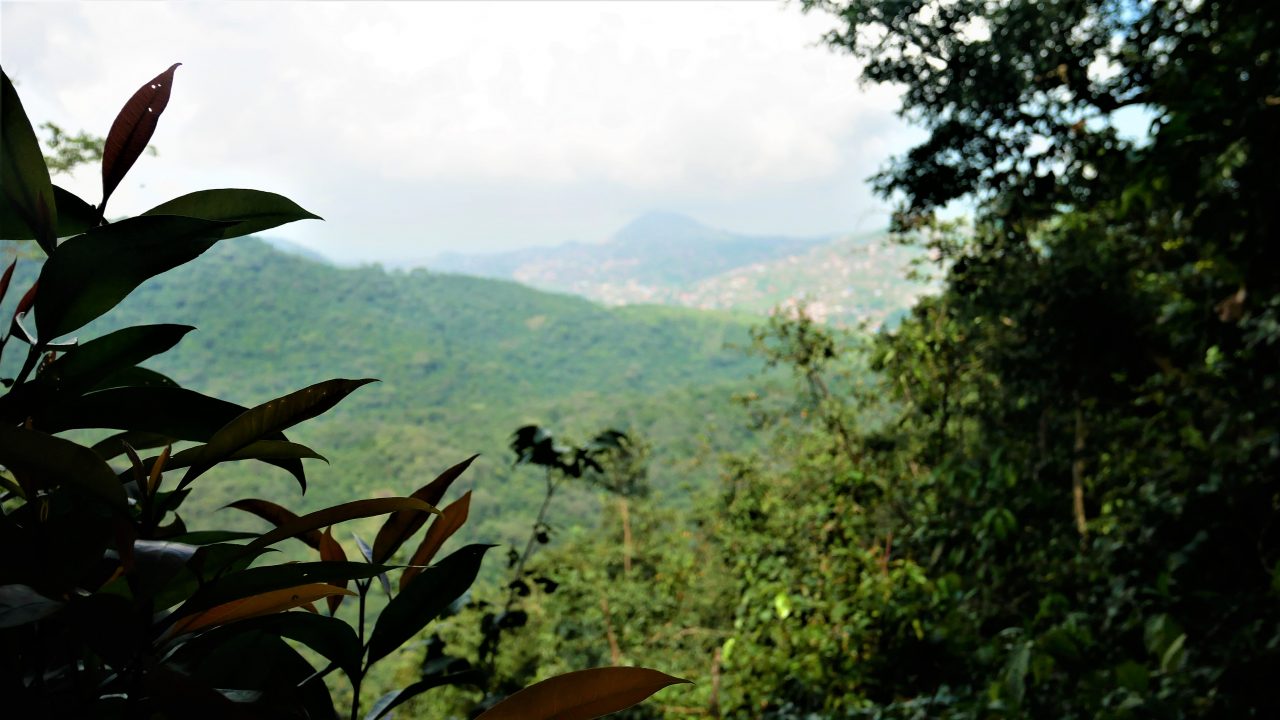
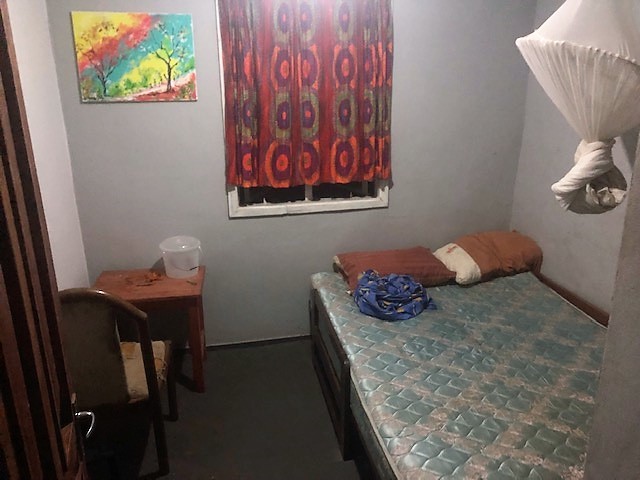
I’ll begin with our home away from home; the volunteer house resides on the Tacugama site in top of the Western peninsula national park. We are surrounded by the sounds of the forest, with creatures from cricket to cicada, always trying to be heard. Although they can be loud, it is a surreal experience about having to pause a Skype call because you can’t hear the person over the chimpanzees. As we lay down after a hard day of work, the chirps and croaks coming through the window are soothing as we fall asleep, safe in the knowledge that the creepy crawlies are on the other side of our mosquito net.
Our Sierra Leone home
Unfortunately, the animals didn’t always agree that they are meant to live in the forest and decided to come visit us inside the house. Rats lived in our ceiling, spiders as large as a bowl moved into our bathroom and ants formed solid black trails, swarming up the legs of anyone that got too close. Once, while Rosie was sat on our wicker sofa, I saw something that almost gave me a heart attack. Poking out through one of the sofa’s holes, an inch from Rosie’s leg, was a black snake. Trying to remain calm and not spook the snake, I pointed left and with a trembling voice said “Rosie, please move that way”. After a quizzical look, and a second “Move that way”, Rosie got up and jumped away as she too saw the snake. We evacuated the house, calling Andrea, the resident vet. Who came to our rescue with two very long sticks. We began turning the house upside down to remove the snake and from behind a cupboard it slithered out the window to freedom. At this point Andrea told us it wasn’t poisonous but in my head I had just saved Rosie from a near death experience.
The rest of our time inside the house were not so dramatic. They consisted of cold showers, hand washing clothes which would never dry and often living without Wi-Fi or Power. With no mains electricity, Tacugama runs of a generator in the day and stored Solar power overnight. Unfortunately, there wasn’t always sun, meaning we had quite a few evenings of candlelit dinners, rationing out the battery left in the laptop and reading the Kindle in bed. We quickly adjust to the new realities of everyday life but both Rosie and I are looking forward to modern conveniences once we head onto Bangkok, our next destination.
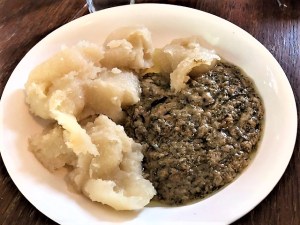
At Tacugama we were catered for by Fatmata, the volunteer housekeeper. She cooked and cleaned for the house and generally made us feel looked after as our “Volunteer Mum”. Before we came to Sierra Leone, we thought this would be a good chance to get healthy and lose a bit of weight. We were wrong. We ate African food, which consists lots of oil, lots of potato and lots of rice. Even the salad contained very few vegetables and lots of oil cooked potatoes. Furthermore, since Fatmata is a really good cook, it tasted delicious meaning I often went back for seconds.
African fufu with traditional Groundnut Soup.
The thing that surprised me most about Sierra Leone was our weekly trips to the supermarkets. There are only three supermarkets in Freetown. Each one only as large as a Tesco metro. Not only did it take us an hour to get to one due to bad roads and traffic, trying to get money out of an ATM meant driving to about five different machines since most of them were out of cash. Once we arrive, everything for sale is imported from the UK, costs at least double what it does back home and What’s in stock changes every week. Out shopping usually consisted of biscuits, beer, laughing cow cheese (Since it doesn’t need refrigeration) and crackers. This was also a possible factor in us not losing weight. The fact you were simple unable to buy things in the capital city really shocked me.
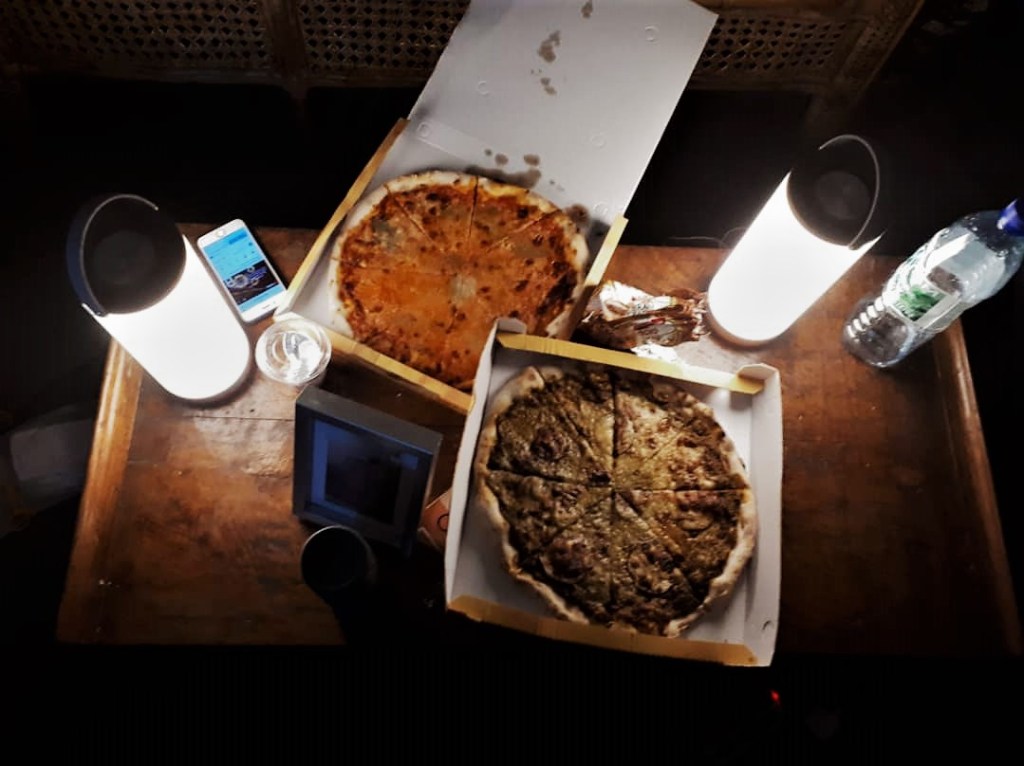
One thing you could do in Sierra Leone was eat out. Although it was made more complicated by needed to get a taxi, we would often go out with the other volunteers for burgers or pizza. One day we made a miraculous discovery that you can get takeaway delivery to Tacugama. Having pizza delivered to the middle of the forest, as everyone watches a movie on a projector was a slice of home.
Pizza delivery in the dark
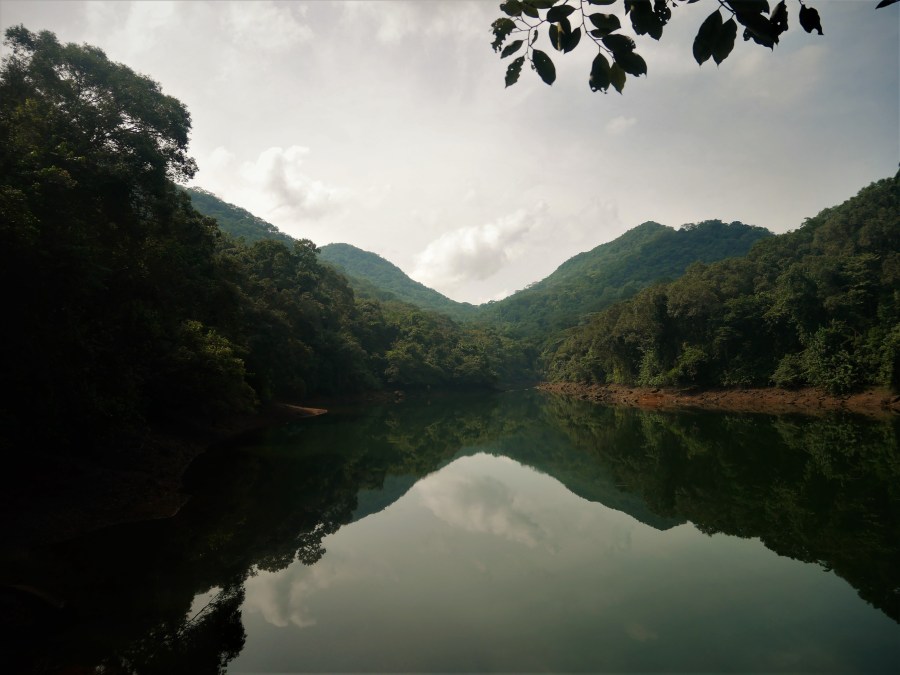
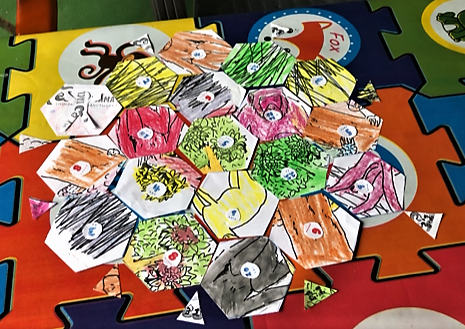
When we first arrived, It was just Catalina, Rosie and me in the volunteer house. We have now been joined by two new volunteers called Josephine and Naomi. The five of use have a lot of evenings to spend together and in addition to movie nights, we also go on walks to the nearby Congo dam and even played Settlers of Catan on a home made board. Being friends with the workers at Tacugama, we even go invited on some nights out in Freetown. All in all, we managed to entertain ourselves despite the lack of a TV or Netflix.
Catan Board made from left over colouring pages
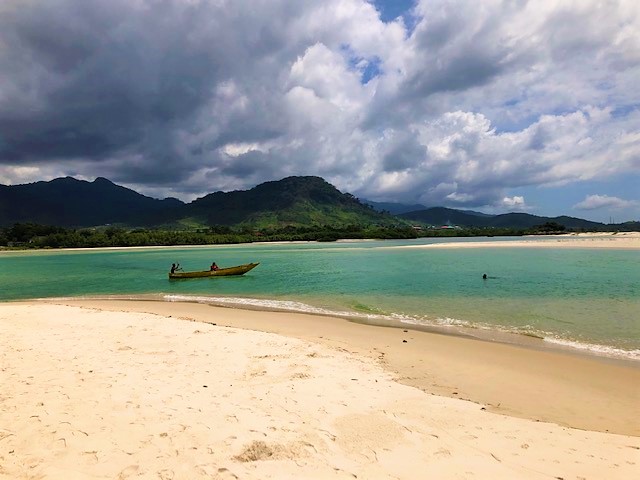
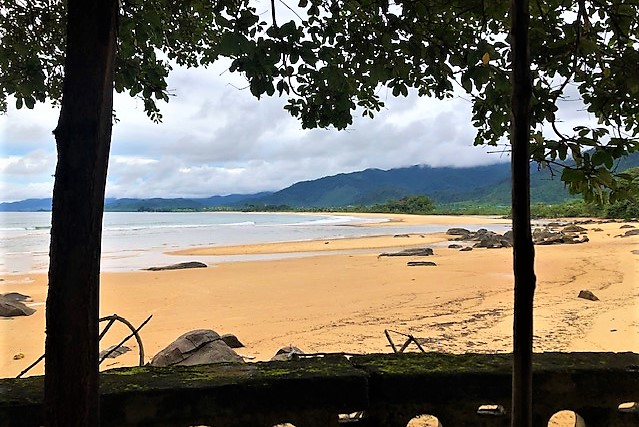
Come rain or shine, on our days off we went to the beach without fail. Stunning coastline surrounds the Freetown peninsula, gentle turquoise waves lap onto warm golden sands behind, rising steeply towards the sky lies the mountainous dense green African forest. Every Monday our trusty taxi driver, Amadu, would drop us off at a different location, where we eagerly explored a new beach.
Lumley: If you want to eat instead of sunbathing, this is where to go. Still within Freetown, the Lumley strip has the nicest hotels, restaurants and even Casinos. Wood-fired pizzas, overlooking the sea with the ultimate treat of ice cream for dessert.
Lakka: To quote our guide book “Lakka is a trusty best friend who you aren’t in love with, but is always there for you when you need it ”. Our nearest beach featuring good food and waves so big they will knock you over and, in Andy case, steal your sunglasses.
River No 2: Although the vegetarian food selection consisted of a plate of chips, this beach makes up for it by having it’s own market. Custom made trousers for everyone, as well as bags and figurines, all as colourful as a candy store.
Bureh: The place to go when we got a 2 day weekend. Spend a night in a tent (With a mattress inside) on the beach, drinking beers from the cool-box which our hosts left outside for us. Nothing is more relaxing than lying on the sand as the sun sets over the horizon.
Tokeh: Where you go if you need a little Luxury (With a price to match). Rooms here have Wi-Fi, air-conditioning and Hot showers. The white sand beach stretches as far as the eye can see and as you lay in your sun lounger, drink in hand, you feel like you might just be at the most beautiful beach in the world.
Despite all the little things we miss from home, the beauty of Sierra Leone and love of getting to work with the chimps more than makes up for it. The both of us couldn’t be happier that we are here and are treasuring every minute of our experience.
I
was giddy with excitement to meet the babies and the wonderful ladies
who look after them. Mama Poseh and Mary are truly inspirational
women, who
care for every chimpanzee that
arrives at Tacugama, showing them
love and kindness. For the animals that come here who are traumatised
and filled with fear, Mama P and Mary make them feel safe and secure.
On my first day, I woke at 6.30am as rain hammered against my windows
and dense grey clouds obscured any
sunlight; it was time to climb out of bed and help Mama P prepare the
babies milk. By the time we had finished mixing the milk, the
sounds of excited squeals filled the air, and small dark hairy
arms groped at the tarpaulins covering
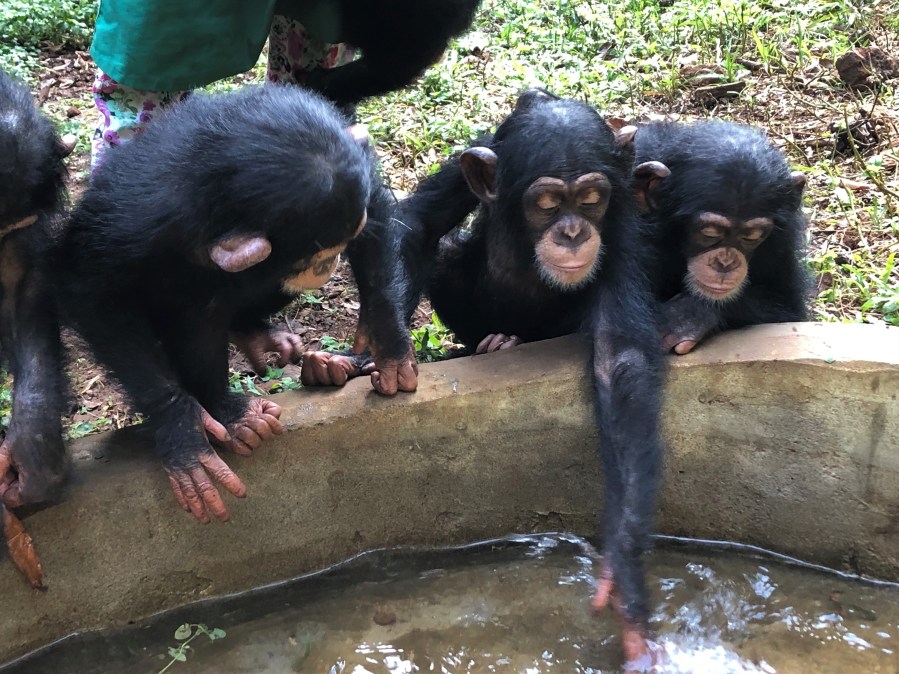
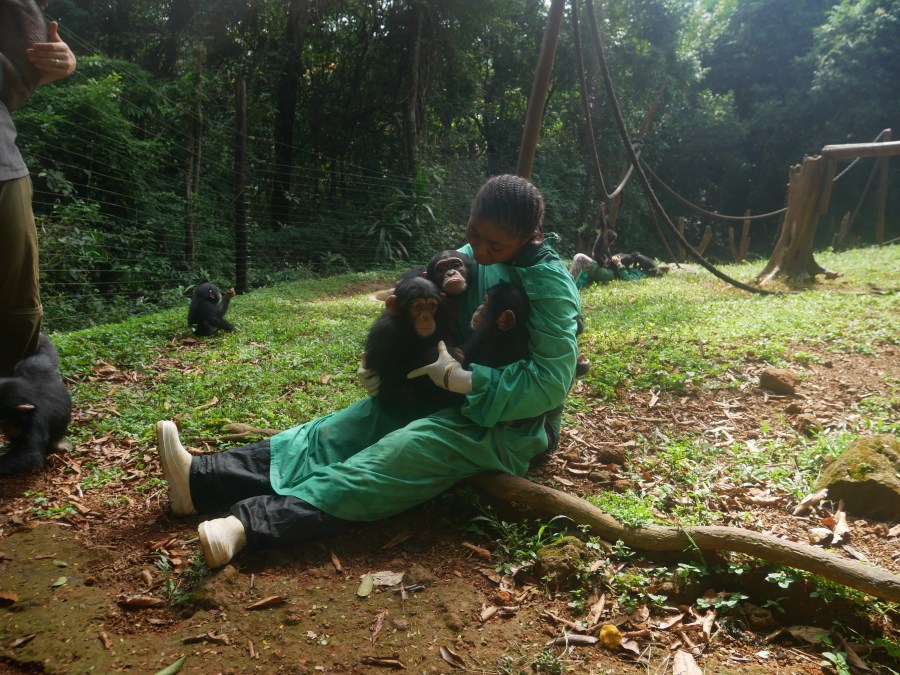
the enclosures. Mama P rolled up the first tarpaulin and the four
babies inside rushed forward, seeking a hug from their mum. As they
reached out to touch her, they were greeted by “I love you, I love
you!”. The babies grabbed her arms and clothes and stroked her face
using any limb they could squeeze through the netting of their cage,
seeking the comfort of a parent and hoping to curry favour
and get their breakfast first. This was the girls group; the
most dominant was the biggest chimp named Lizzie, her best friend was
the smallest member of the group Fifo, she had an angelic face but
was a feisty girl. Ramba and Miata complete the group. These two are
the best of friends and love to cuddle and tickle each other. Before
I came, I had no idea that chimps laugh just like human children and
they love to have their tummies and neck tickled!
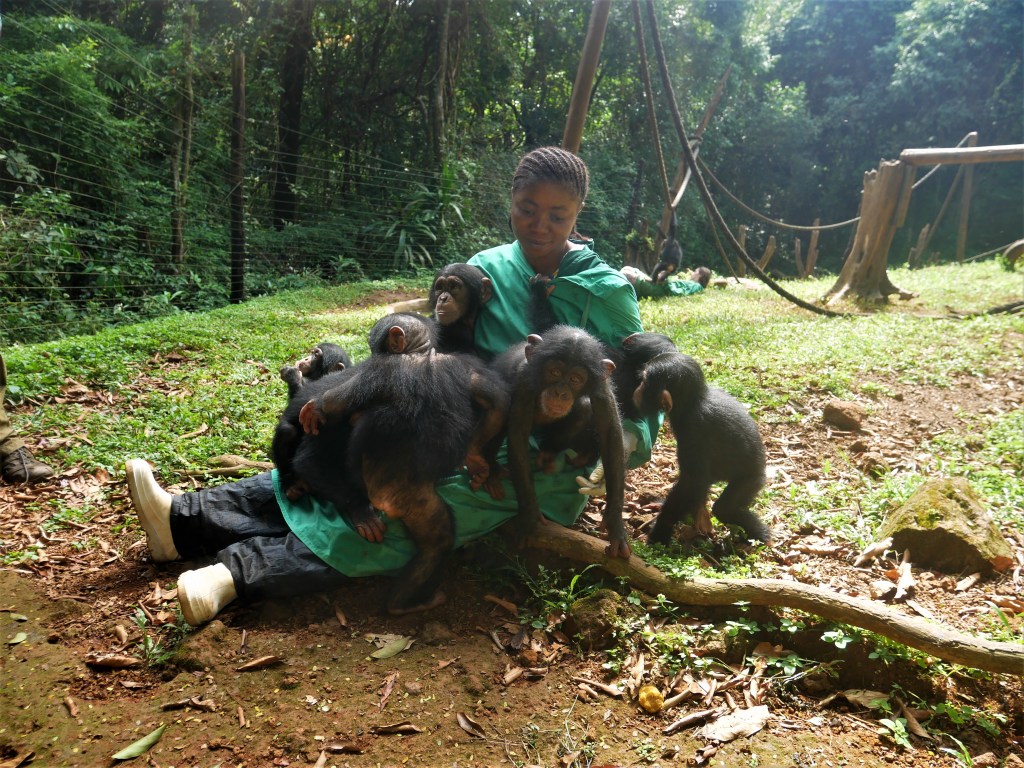
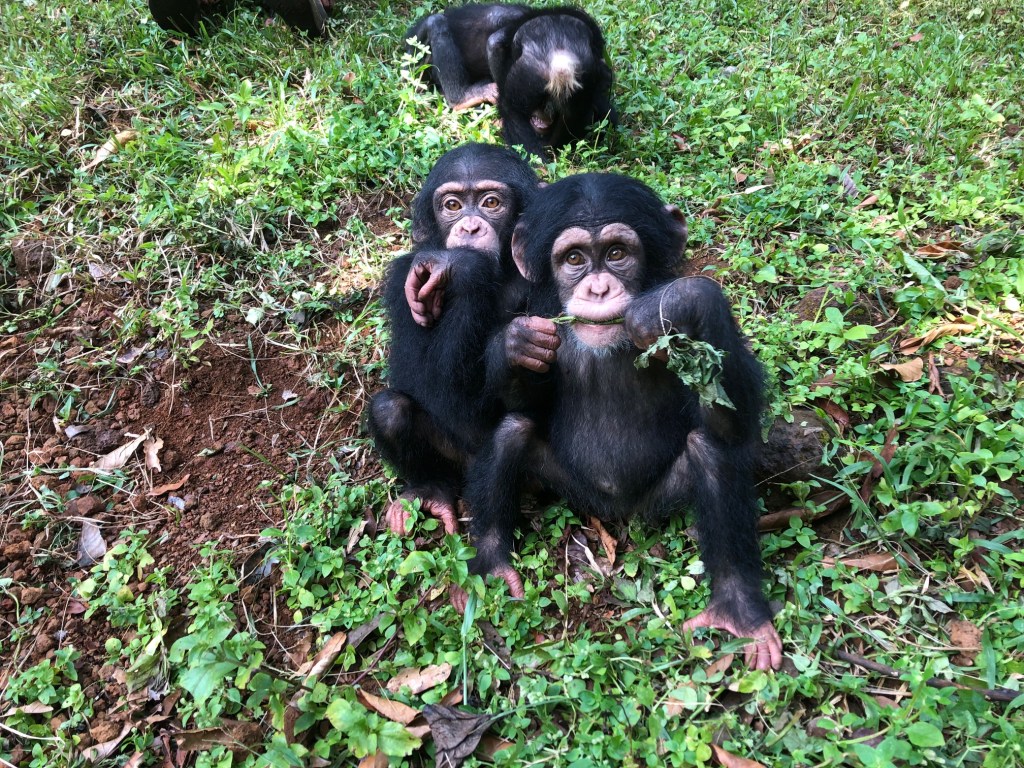
Mary playing with the babies outside, they all loved cuddles with their surrogate Mum! Fifo and Osmund trying to find a snack.
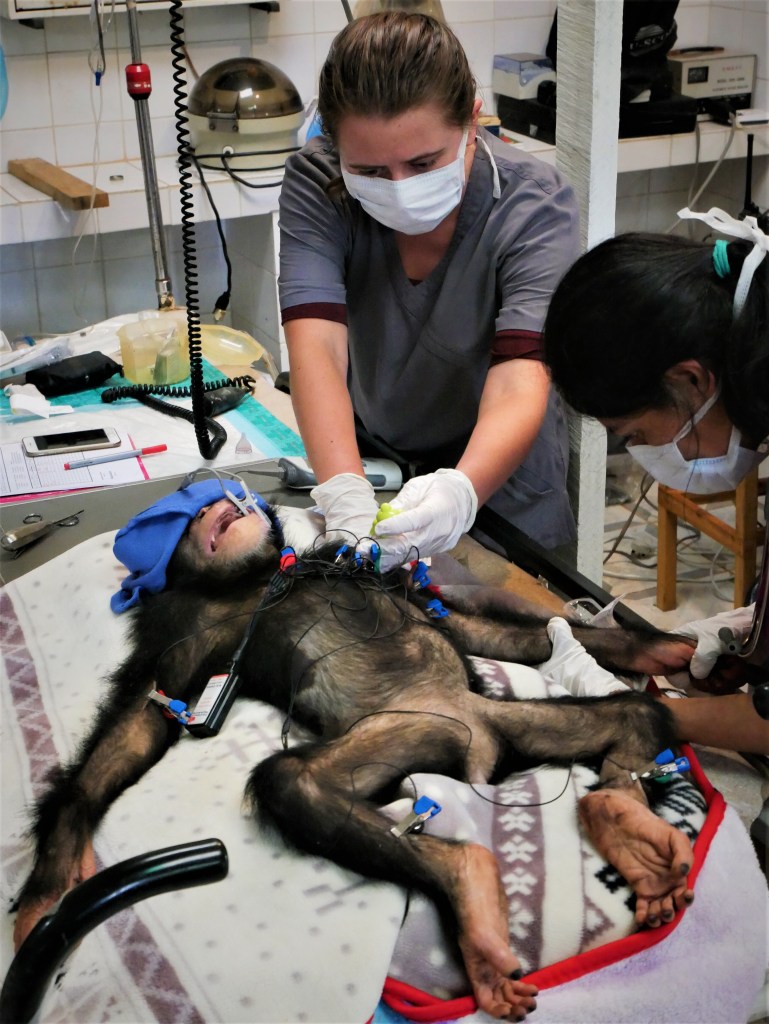
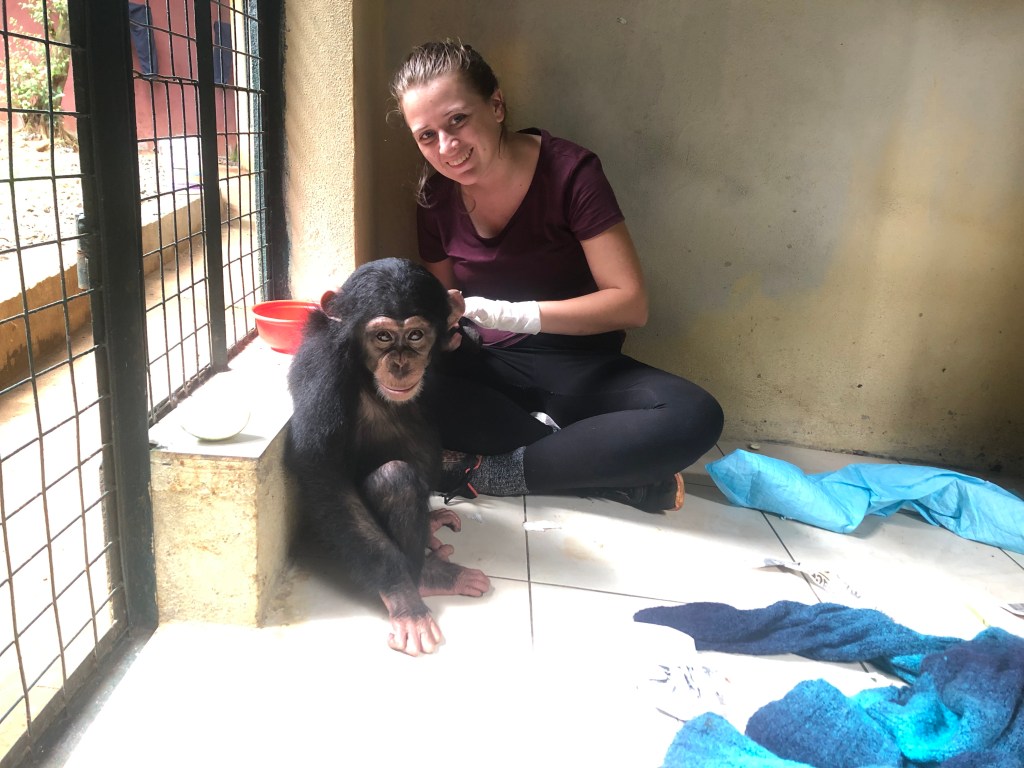
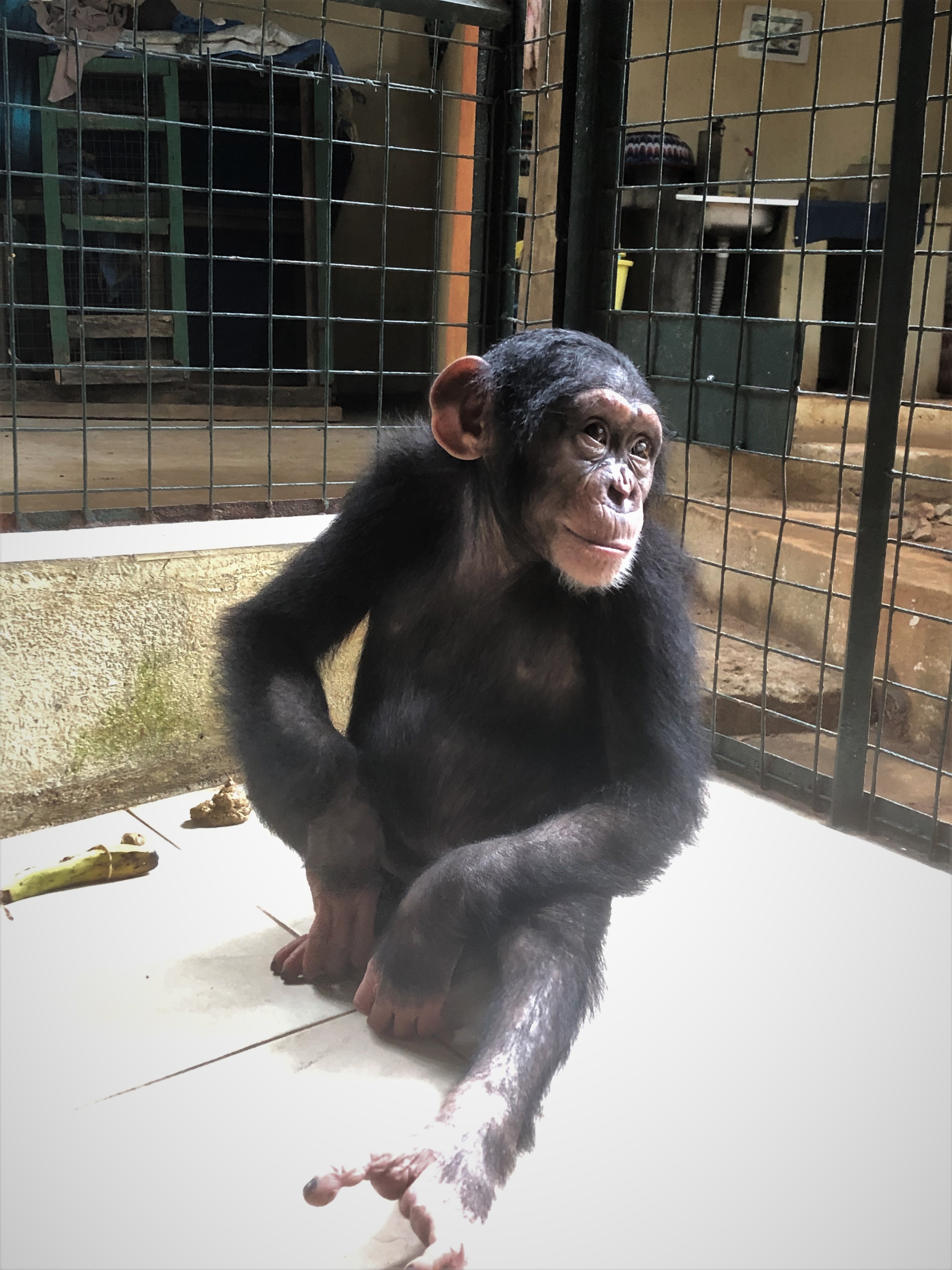
After one month, I had gotten to know all the babies very well. Every day, I joined Mama P to give them their milk, and was helping to clean the enclosures. It had been decided that Andy and I would spend less time on enrichment, instead I would work with the babies full time and Andy would join the Tacugama Conservation and Outreach Project (TCOP) to work on a conservation football tournament being hosted in the neighbouring district of Mobunda. After only 1 week of working full time with the babies the resident vets, Andrea and Juliette, approached me and asked if I would be willing to look after Jean, one of the chimps in quarantine. Every chimp rescued by Tacugama has suffered a lot of trauma and the sanctuary believes that the main reason they have been orphaned is as a by-product of the bush meat trade. There is a very shocking statistic that for every orphan that is taken to be sold as a pet, 8-10 adult chimpanzees have been killed. However, Jean was in a particularly bad way; she was emaciated and had infected wounds all over her body that had gotten so bad that she smelled atrocious. Nobody was sure if she would survive. By the time I was introduced to her she had been living at the sanctuary for 1 month. Inside her enclosure she lay on her back, motionless and silent in the fern green metal crate that she was originally rescued in, barely noticing my presence. Even after a month here, she was extremely anxious and afraid, making it terribly challenging to get her to take medicine or even eat or drink. For two weeks, I struggled with her every day in vain to get her to eat or drink, she was so stubborn that I had practically given up on her medications and I was painfully aware that she was declining and needed intervention.
Juliette and I during Jeans health check.
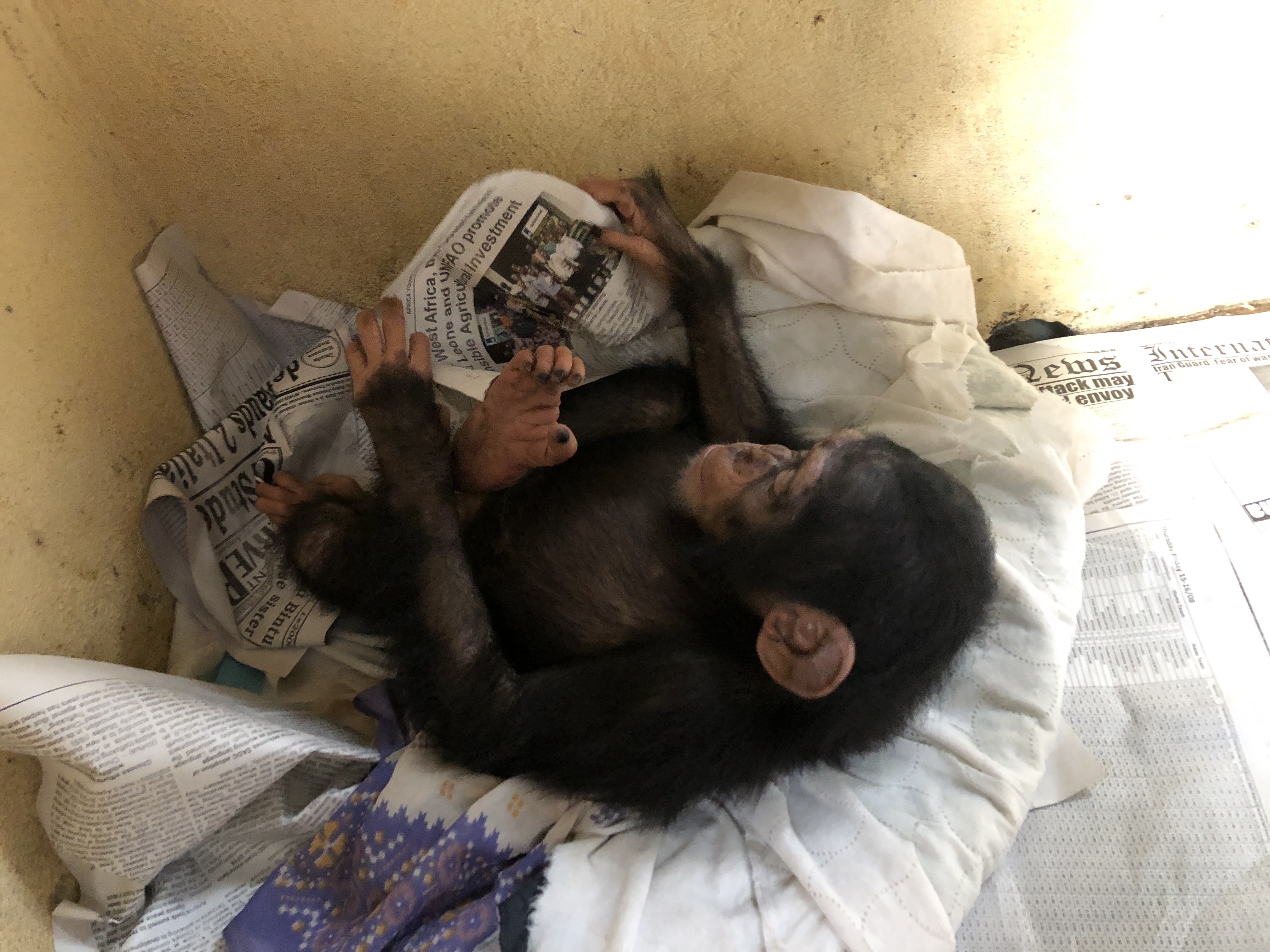
This led to her third health check, where we found she had shotgun pellets lodged in her body. The vets were able to remove the one from her hand, however there were a further two pellets in her skull and chest; on top of this her X-Ray revealed a broken collar bone that was previously undiagnosed. After the health check, her medication was reviewed and swapped to a stronger painkiller that was delivered intramuscularly, rather than orally. Almost immediately after she had come around from the anaesthetic, her appetite rapidly improved; she was treated like a princess and fed all her favourite foods. Even the director Bala was bringing in most favourite food, papaya, which led to me and Juliette half joking, half serious, that the papaya saved her life! From here on her recovery astonished me every day, slowly, slowly, day by day, she started to eat more food and different types of fruit, even drinking her milk, so that after a few days we could deliver her medication in her milk rather than by injection. I have often wondered if she had some understanding that by taking the medicine, we wouldn’t have to inject her, or that on some level she knew that we were helping her and the medication would make her better. Following on from her health check, Jean’s personality continued to brighten and she started to interact more with the world around her. She would love it when I would groom her; spending hours showing me her back so I could comb through her hair. One day she reached up and ran one hand through my hair, followed by her other hand, which started shifting through the strands of hair that had been pulled back into a short pony tail at the back of my head. I felt honoured by this sign of affection and the thought that we were developing a mutual trust. Out of the limited things she enjoyed, nest building was another of her interests; she would scavenge her enclosure for material, gathering up shredded newspaper from the floor that I had scattered around earlier, carrying it back to her bed, wedged between her thigh and stomach. Carefully, she folded over the edges of the blankets and strips of newspaper and tucked them under her feet to hold them in place. The end result was a lopsided crumble of bedding, where she finally lay her head down on to rest.
It was inevitable that I felt exceptionally guilty to be leaving her, never the less I felt that my time with Jean had helped immensely and that on my departure she was happier, stronger and more resilient.
The
first week of volunteering at Tacugama was the worst week because I
was in quarantine, this meant I could not come in close contact with
the chimps. This was a precaution all volunteers had to take to
prevent passing contagious illnesses to the animals, however I was
full of anticipation and found the feeling of waiting incredibly
frustrating; I couldn’t wait to have a more involved role with the
animals and I even missed out on the sanctuary tour due to the heavy
rains. Once Andy and I had finished quarantine, our first task as
volunteers was making enrichment.
Andy holding a mornings enrichment for the chimpanzees in Mortes’ group.
There
was a new enrichment that was dirty and empty, when we first saw it
it was in dire need of a deep clean. We were armed with bleach and
coconut brooms; Andy tackled the spiders and mice while I handled the
rest. After a week of making enrichment every day for the chimps it
felt like we were getting into a routine. Already we knew all the
keepers and were working on learning the names of the chimpanzees who
were receiving the enrichment.
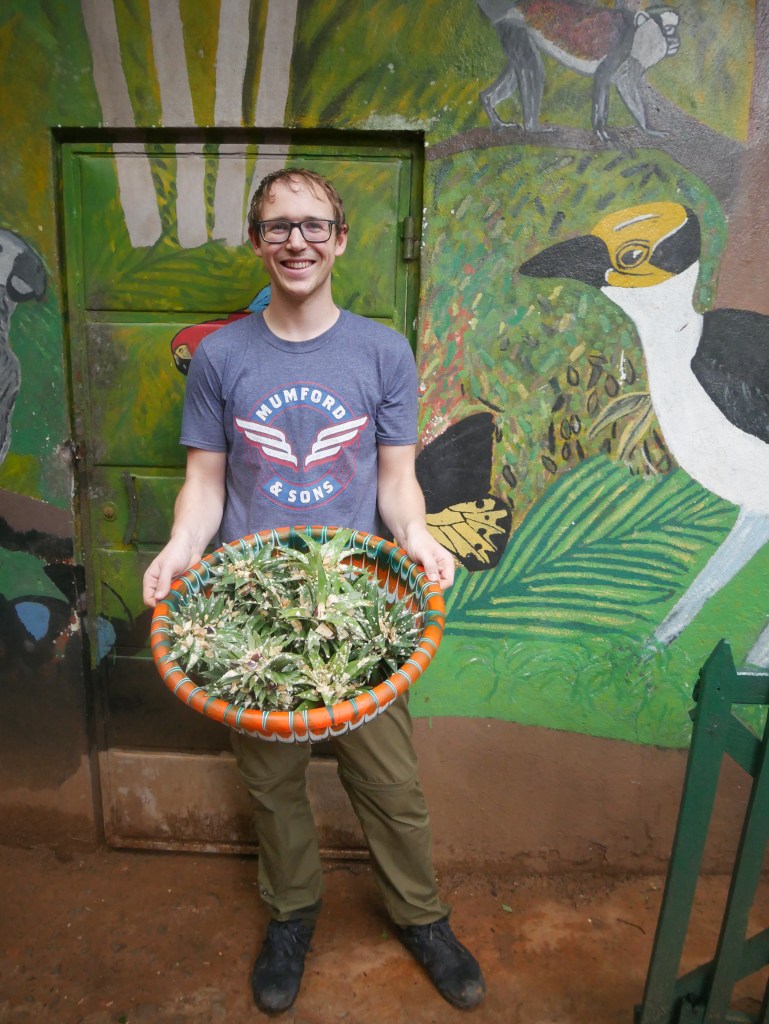
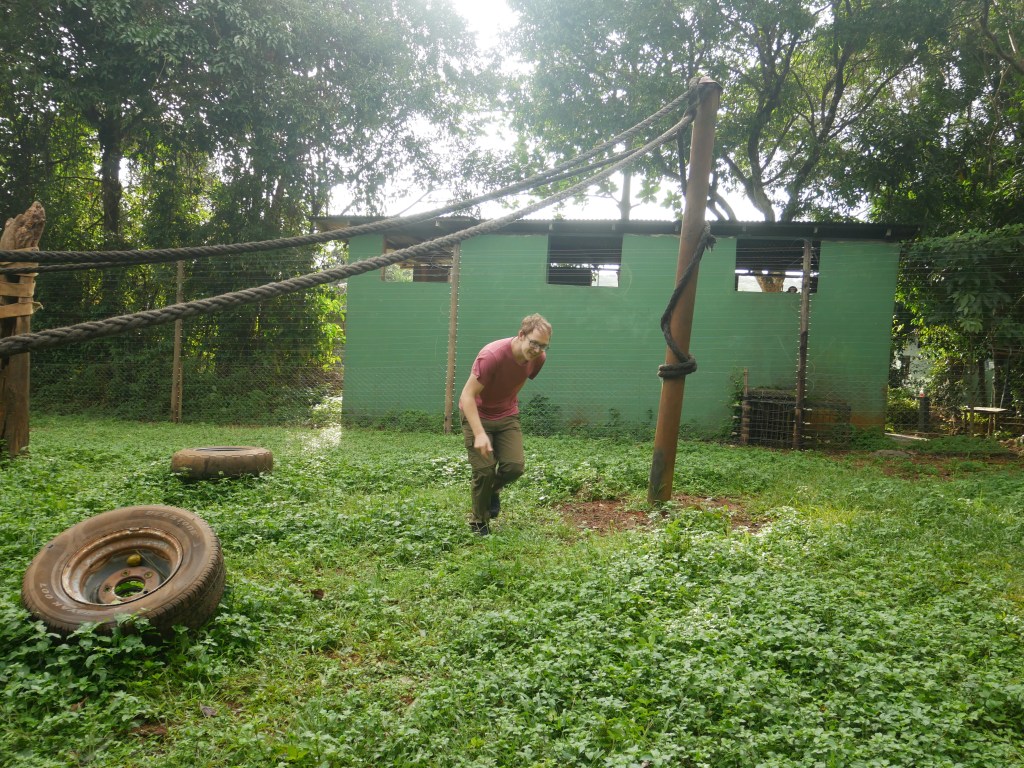
Andy hiding fruit around the chimps enclosure before they’re released.
My
favourite was a male in Rosalind group called Abu, he had a very
friendly personality and was always excited to get his enrichment;
you could tell by his happy pant hoot noises. In his group he was the
alpha male, however there was a rival alpha (called Jazzy), these two
had alternate weeks with one outside in the forest enclosure and one
inside the dens. In the wild rival alpha males would fight for the
position, potentially dividing the group or leading to injury or
death of one of the males. At Tacugama they have a responsibility to
care for every animal, so this was the best solution they could
provide.
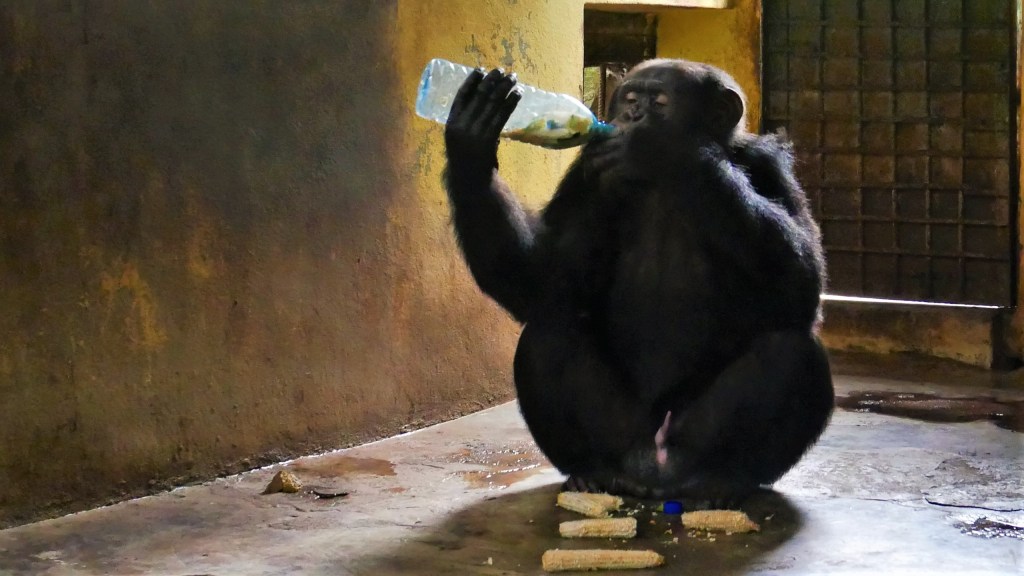
Abu enjoying his enrichment.
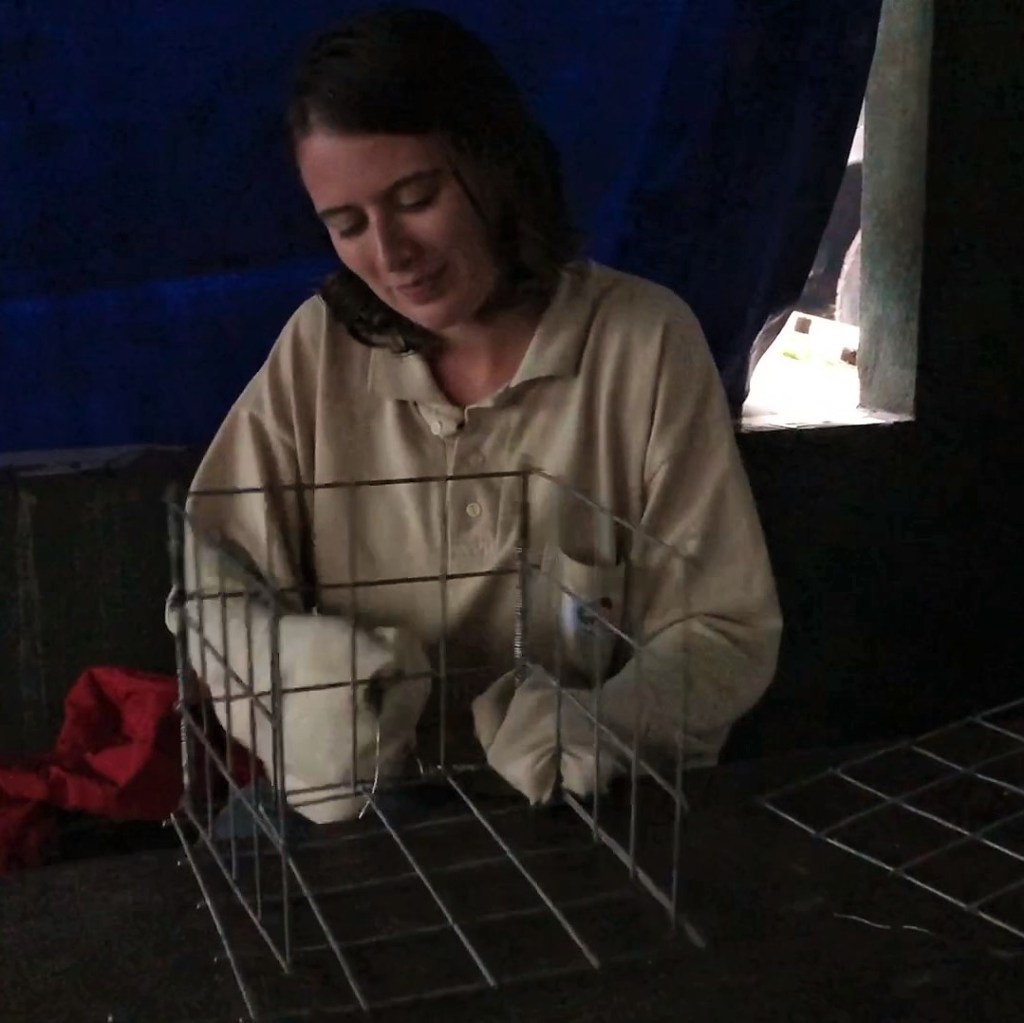
In
the afternoons, we both also work on enrichment. For our first
project we made foraging cages, the purpose of them was to make it
harder for the chimp to retrieve the food inside and also encourage
the use of tools. Physically making the cages had its challenges, we
started with a large sheet of metal mesh and cut out the six sides to
make a cube, at first Andy used a pair of pliers to cut through the
rods, luckily Kim invested in a pair of wire cutters which then made
this part much, much easier. Then we used metal wire to bind the
sides together, this stage was the most time consuming and by the end
we had pretty sore fingers. However, it was a relief to be making the
cages indoors as by lunchtime were usually already wet from the rain
and this meant we were saved from becoming even soggier.
Busy in the afternoon building cages for foraging.
It
was 4am when the plane landed and I glimpsed at the first African
land I’d ever seen; from the start it was clear that Sierra Leone was
a very different place from home. Apart from one lost bag (Andy’s,
not mine) and getting separated from the other passengers on our way
to the sea coach, things were going slowly but mostly smoothly; the
same could not be said for the sea coach. The sun was yet to emerge
and from the dock, in the darkness, the small light of the ferry
could be seen rising over the crest of wave and then disappearing
into its trough. As it approached I made my way hesitantly to the
floating jetty and looked deep inside myself for the courage to face
what was sure to be a terrible crossing. The other passengers were
not so calm. One burst rather loudly into a spontaneous and fervent
prayer to Jesus for the safe return of our vessel.
In
light of the bumpy crossing, I was even more delighted to see Abu and
Chloe from Tacugama waiting for us. By the time we reached the
junction to the sanctuary, my stomach had just about recovered from
the sea coach, which was just as well because the last part of the
road was terrible. But I felt a huge sense of relief that the journey
was over and we had made it to what would be home for the next three
months.
After
a brief stay in the Eco-lodges Andy and I settled in to the volunteer
house. We shared room 3 and we also shared the house with another
volunteer called Catalina, a paediatrician from Argentina.
Catalina
generously showed us the ropes of the house, including the wifi
passwords (very important for my worried mum) and told us all her
stories of her experience of Tacugama so far, as she had already been
living there for 4 weeks; the three of us spent many evenings
chatting away about all sorts of topics. In the house we had a
shared kitchen, a common living space, two bathrooms and a veranda
which overlooked the greenhouses and an old parrot enclosure, it was
not the most beautiful view, but there was a comfortable hammock. We
were made extremely welcome by Fatmata, the volunteer house keeper;
she was a fantastic cook and she looked after us so well it felt
she’s the “volunteer mum”. There were also many challenges
to living at Tacugama:
Firstly and for me the worst thing, was the cold showers.
The rain!! During rainy season the rain really was relentless, so in
the day you would get soaking wet every time you went outside; also
the dense clouds prevent the solar panels from charging so we often
went without power in the evenings.
Boiling water every evening, so it was safe and cool enough to drink
the following day.
Mould. Because the climate was super humid and there was a lot of
rain everything gets mouldy, luckily nothing a good wash and some
sunshine couldn’t fix though.
Nevertheless, We have arrived in Sierra Leone, Made it to Tacugama and are ready for the adventure ahead of us!
 Kennedy's Crack the Cabin