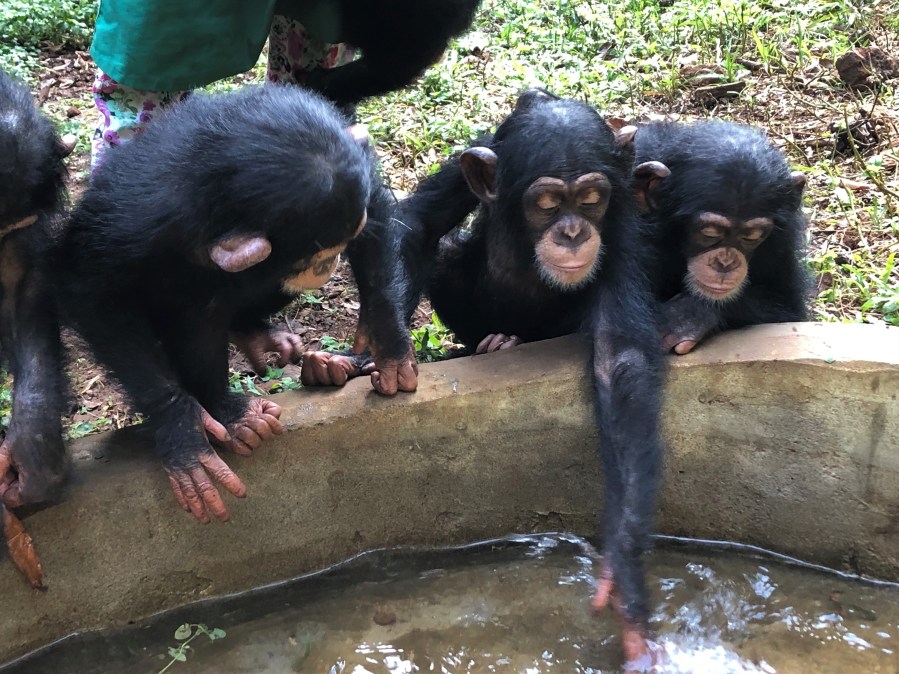
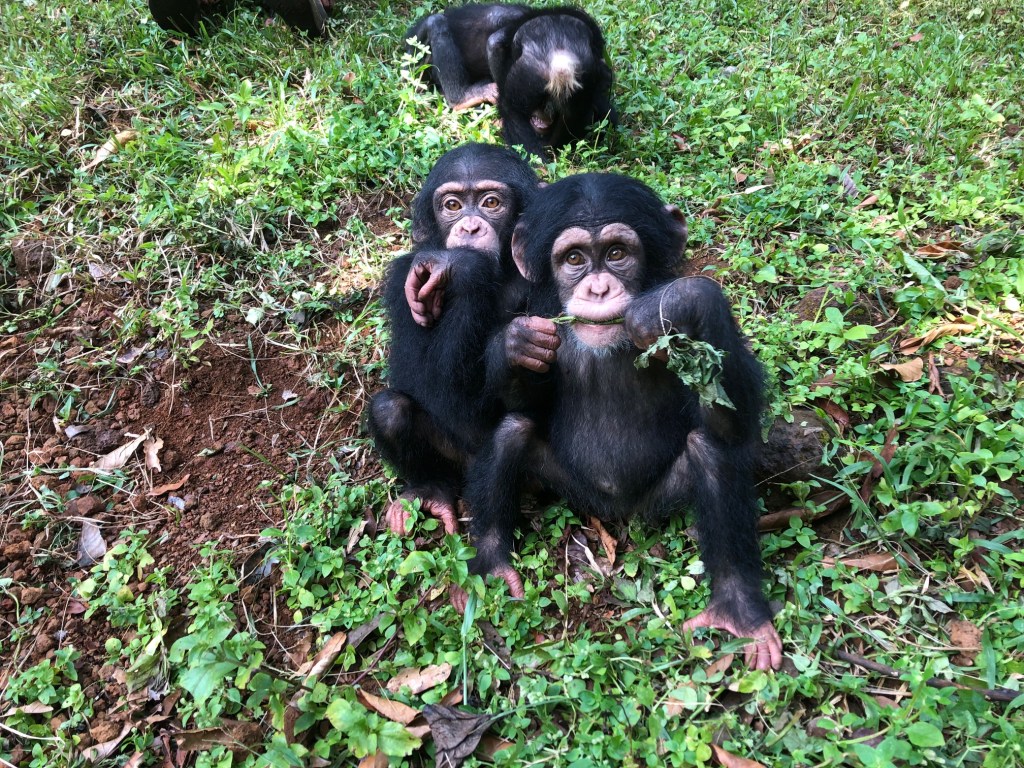
I was giddy with excitement to meet the babies and the wonderful ladies who look after them. Mama Poseh and Mary are truly inspirational women, who care for every chimpanzee that arrives at Tacugama, showing them love and kindness. For the animals that come here who are traumatised and filled with fear, Mama P and Mary make them feel safe and secure. On my first day, I woke at 6.30am as rain hammered against my windows and dense grey clouds obscured any sunlight; it was time to climb out of bed and help Mama P prepare the babies milk. By the time we had finished mixing the milk, the sounds of excited squeals filled the air, and small dark hairy arms groped at the tarpaulins covering the enclosures. Mama P rolled up the first tarpaulin and the four babies inside rushed forward, seeking a hug from their mum. As they reached out to touch her, they were greeted by “I love you, I love you!”. The babies grabbed her arms and clothes and stroked her face using any limb they could squeeze through the netting of their cage, seeking the comfort of a parent and hoping to curry favour and get their breakfast first. This was the girls group; the most dominant was the biggest chimp named Lizzie, her best friend was the smallest member of the group Fifo, she had an angelic face but was a feisty girl. Ramba and Miata complete the group. These two are the best of friends and love to cuddle and tickle each other. Before I came, I had no idea that chimps laugh just like human children and they love to have their tummies and neck tickled!
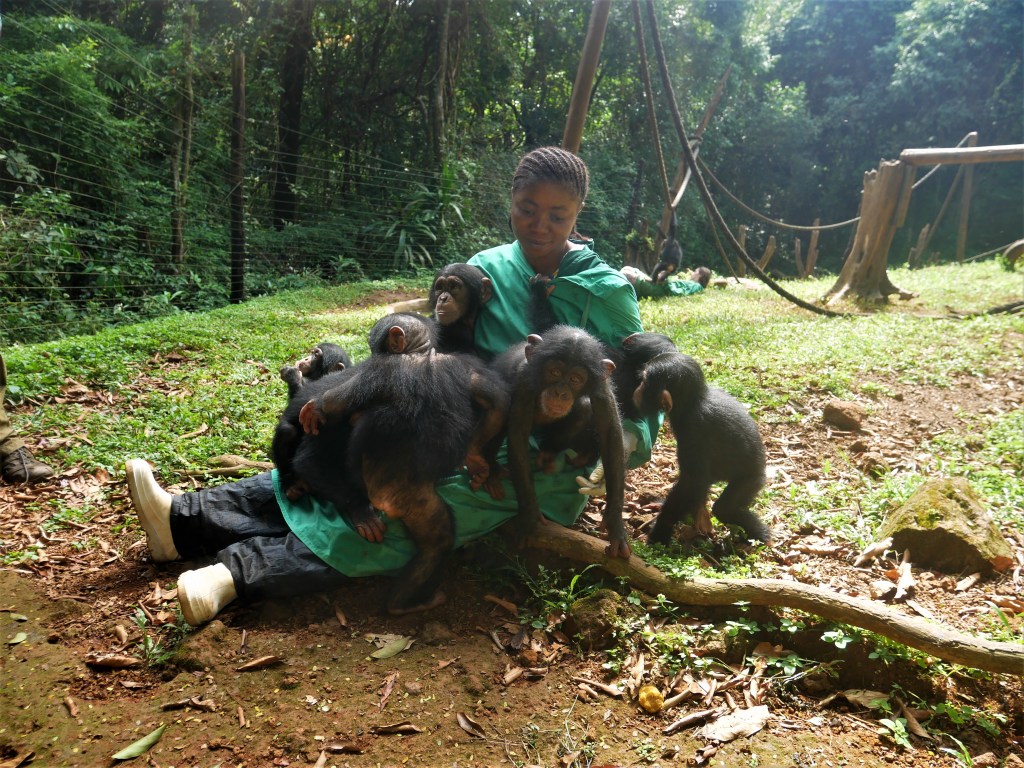
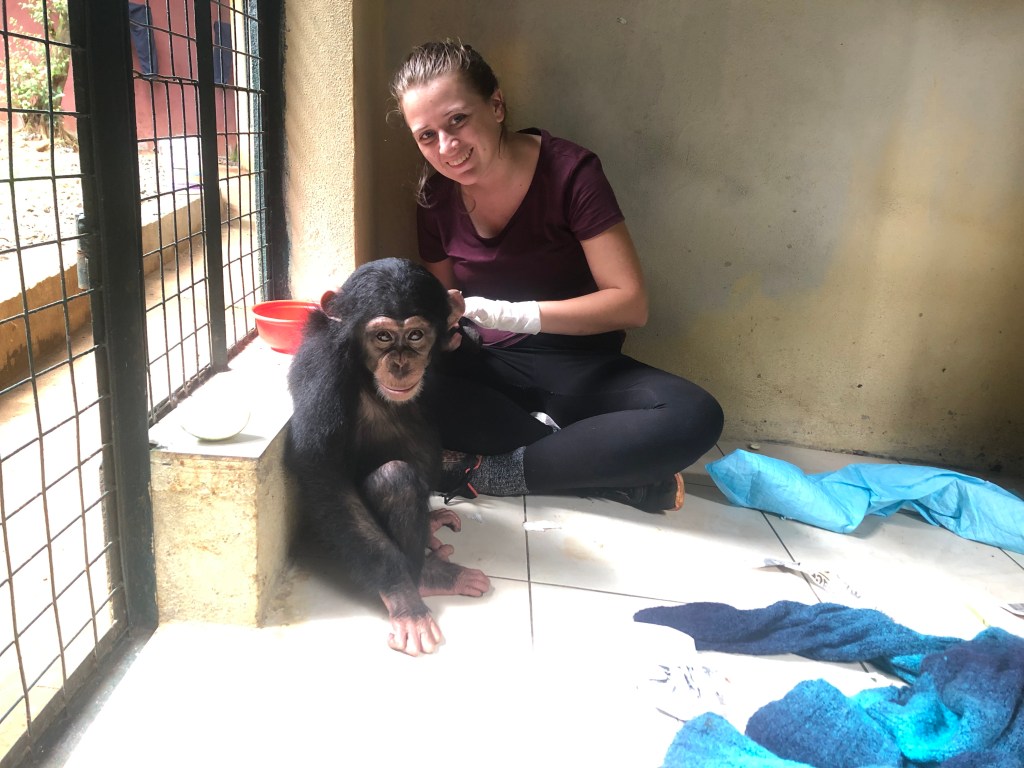
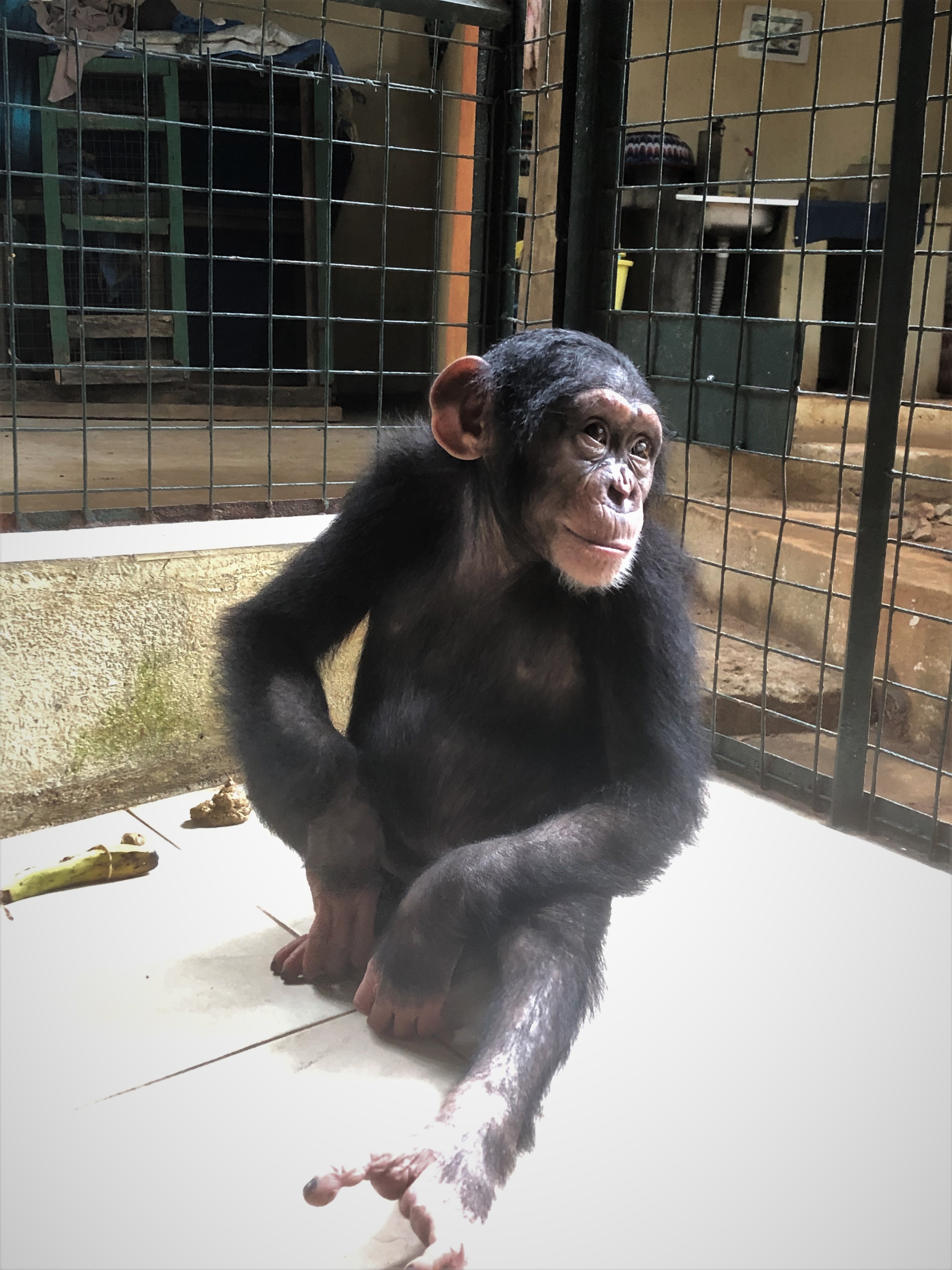
After one month, I had gotten to know all the babies very well. Every day, I joined Mama P to give them their milk, and was helping to clean the enclosures. It had been decided that Andy and I would spend less time on enrichment, instead I would work with the babies full time and Andy would join the Tacugama Conservation and Outreach Project (TCOP) to work on a conservation football tournament being hosted in the neighbouring district of Mobunda. After only 1 week of working full time with the babies the resident vets, Andrea and Juliette, approached me and asked if I would be willing to look after Jean, one of the chimps in quarantine. Every chimp rescued by Tacugama has suffered a lot of trauma and the sanctuary believes that the main reason they have been orphaned is as a by-product of the bush meat trade. There is a very shocking statistic that for every orphan that is taken to be sold as a pet, 8-10 adult chimpanzees have been killed. However, Jean was in a particularly bad way; she was emaciated and had infected wounds all over her body that had gotten so bad that she smelled atrocious. Nobody was sure if she would survive. By the time I was introduced to her she had been living at the sanctuary for 1 month. Inside her enclosure she lay on her back, motionless and silent in the fern green metal crate that she was originally rescued in, barely noticing my presence. Even after a month here, she was extremely anxious and afraid, making it terribly challenging to get her to take medicine or even eat or drink. For two weeks, I struggled with her every day in vain to get her to eat or drink, she was so stubborn that I had practically given up on her medications and I was painfully aware that she was declining and needed intervention.
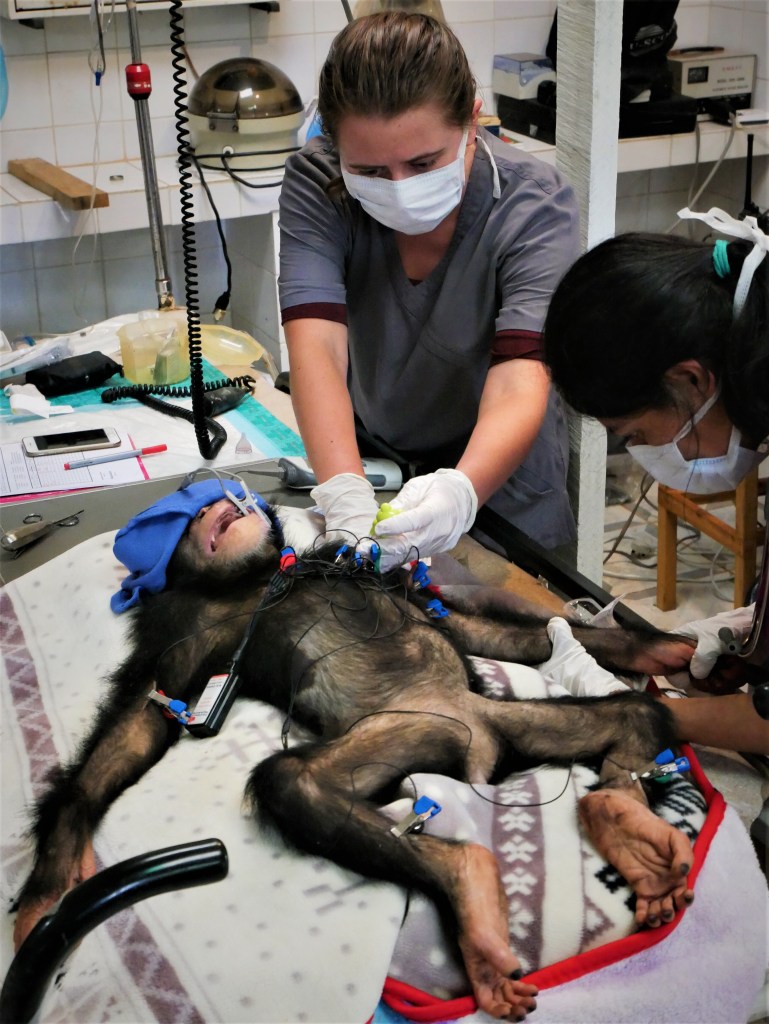
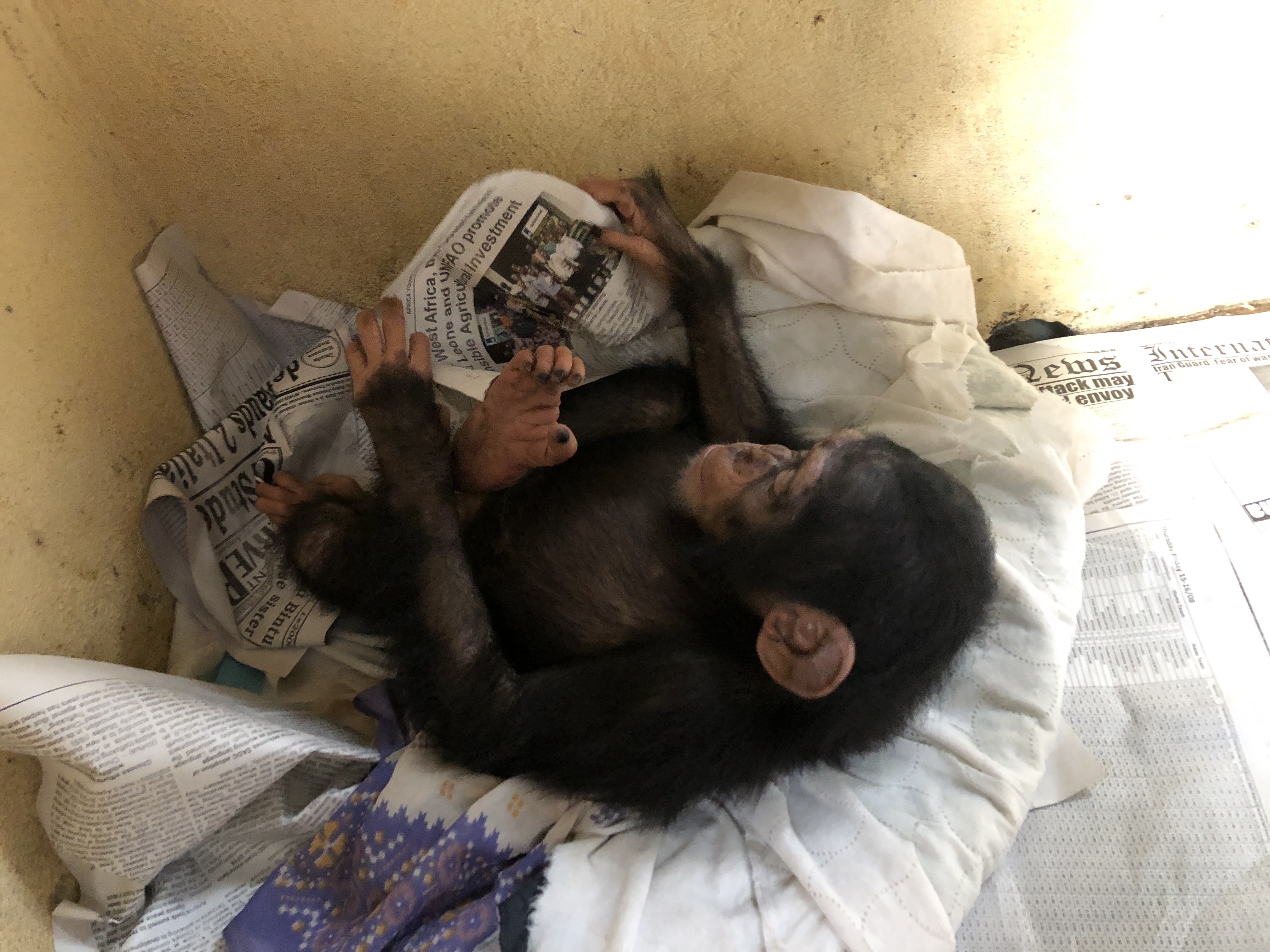
This led to her third health check, where we found she had shotgun pellets lodged in her body. The vets were able to remove the one from her hand, however there were a further two pellets in her skull and chest; on top of this her X-Ray revealed a broken collar bone that was previously undiagnosed. After the health check, her medication was reviewed and swapped to a stronger painkiller that was delivered intramuscularly, rather than orally. Almost immediately after she had come around from the anaesthetic, her appetite rapidly improved; she was treated like a princess and fed all her favourite foods. Even the director Bala was bringing in most favourite food, papaya, which led to me and Juliette half joking, half serious, that the papaya saved her life! From here on her recovery astonished me every day, slowly, slowly, day by day, she started to eat more food and different types of fruit, even drinking her milk, so that after a few days we could deliver her medication in her milk rather than by injection. I have often wondered if she had some understanding that by taking the medicine, we wouldn’t have to inject her, or that on some level she knew that we were helping her and the medication would make her better. Following on from her health check, Jean’s personality continued to brighten and she started to interact more with the world around her. She would love it when I would groom her; spending hours showing me her back so I could comb through her hair. One day she reached up and ran one hand through my hair, followed by her other hand, which started shifting through the strands of hair that had been pulled back into a short pony tail at the back of my head. I felt honoured by this sign of affection and the thought that we were developing a mutual trust. Out of the limited things she enjoyed, nest building was another of her interests; she would scavenge her enclosure for material, gathering up shredded newspaper from the floor that I had scattered around earlier, carrying it back to her bed, wedged between her thigh and stomach. Carefully, she folded over the edges of the blankets and strips of newspaper and tucked them under her feet to hold them in place. The end result was a lopsided crumble of bedding, where she finally lay her head down on to rest.
It was inevitable that I felt exceptionally guilty to be leaving her, never the less I felt that my time with Jean had helped immensely and that on my departure she was happier, stronger and more resilient.
 Kennedy's Crack the Cabin